Hydroxyzine is a sedating antihistamine. While it was originally marketed to treat allergic conditions, it is now used more commonly to promote sleep and to for the treatment of anxiety. It has become an alternative to benzodiazepines because it does not carry the same risks of dependence and abuse.
Hydroxyzine is commonly used during pregnancy, but what do we know about its reproductive safety? Because it is an older medication (available since 1957), we do not have as many rigorous studies investigating its safety during pregnancy as for newer medications, including the SSRIs.
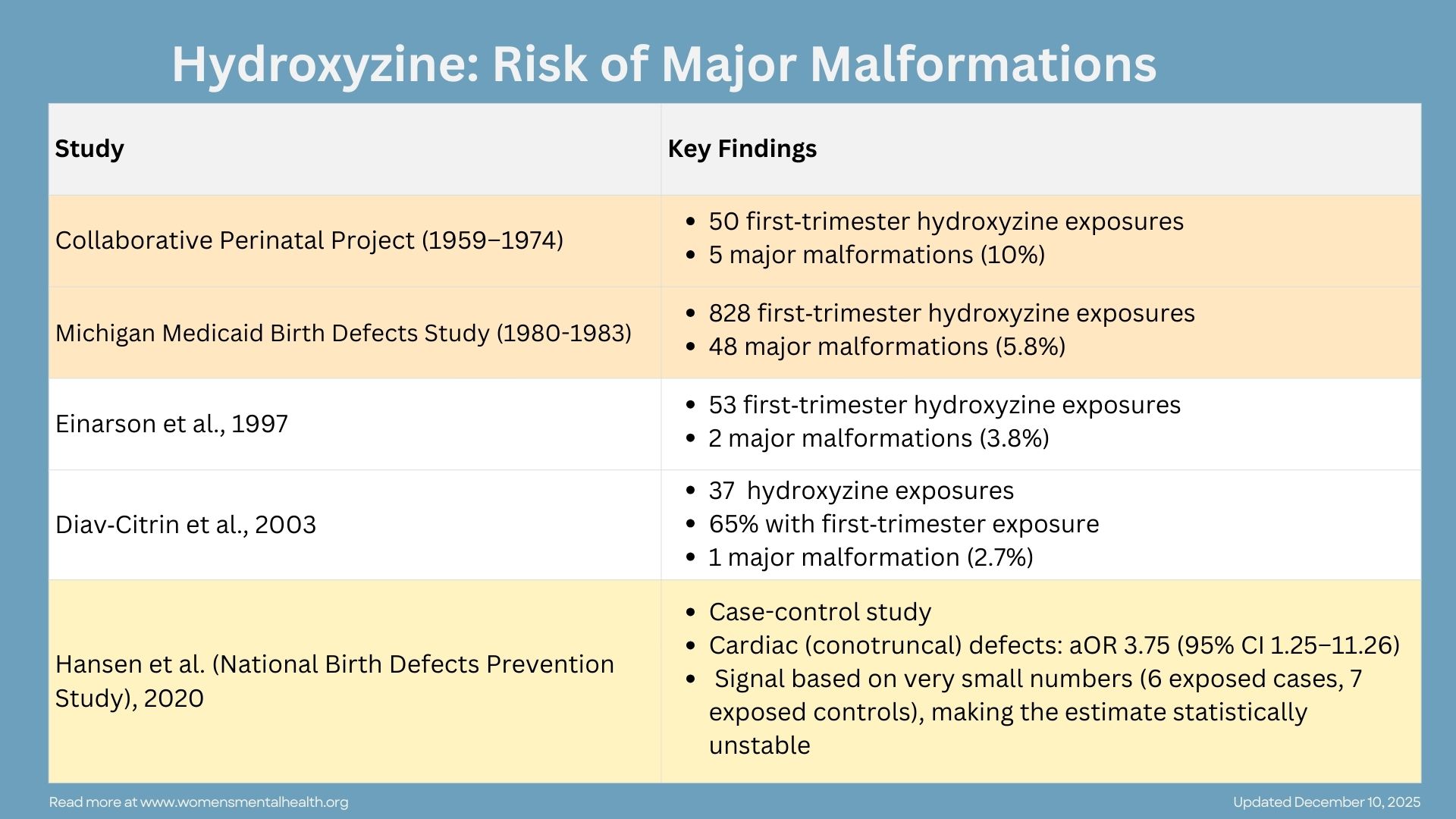
Data on the use of hydroxyzine during pregnancy includes several older observational studies, two small cohort studies, and a recent case-control study from 2020. If you include the observational studies (Collaborative Perinatal Project and the Michigan Medicaid Birth Defects Study described by Einarson et al, 1997), there are around 960 hydroxyzine exposures in the literature. However, those early studies were less rigorous and did not include information on other potentially relevant exposures.
If we exclude those earlier studies, we have less than 100 exposures, a number that is too small to provide a meaningful estimate of risk. The case-cohort study only included 13 hydroxyzine exposures, again making it difficult to get a precise estimate of risk.
The Clinical Bottom Line
While the data on hydroxyzine do not suggest a significant risk of major malformations, the small number of exposures makes it difficult to definitively conclude the lack of risk. Larger, more rigorously performed studies are needed to better understand and precisely define the risks associated with the use of hydroxyzine during pregnancy.
For those who are using hydroxyzine for sleep problems and anxiety, we would recommend considering others options that have a more robust safety profile.
- Cognitive-behavioral therapy may be helpful and may facilitate tapering of the medication
- Doxylamine is also a sedating antihistamine that has been well-studied during pregnancy and does not increase risk for malformations
- For managing anxiety, optimize treatment with an SSRI/SNRI
- Judicious use of benzodiazepines, typically lorazepam or clonazepam in patients at low risk for SUD or substance misuse
- For sleep, consider tricyclic antidepressants or mirtazapine, both of which are sedating
References
Einarson A, Bailey B, Jung G, Spizzirri D, Baillie M, Koren G. Prospective controlled study of hydroxyzine and cetirizine in pregnancy. Ann Allergy Asthma Immunol. 1997 Feb;78(2):183-6.
Diav-Citrin O, Shechtman S, Aharonovich A, Moerman L, Arnon J, Wajnberg R, Ornoy A. Pregnancy outcome after gestational exposure to loratadine or antihistamines: a prospective controlled cohort study. J Allergy Clin Immunol. 2003 Jun;111(6):1239-43.
Hansen C, Desrosiers TA, Wisniewski K, Strickland MJ, Werler MM, Gilboa SM. Use of antihistamine medications during early pregnancy and selected birth defects: The National Birth Defects Prevention Study, 1997-2011. Birth Defects Res. 2020 Oct; 112(16): 1234-1252.